| Tooth Decay
What causes tooth
decay?
Your teeth are
covered with a sticky film of bacteria, called plaque. Within
this film, there are thousands of different types of bacteria.
Of all these many different types of bacteria, only one causes
tooth decay. That bacterium is called Strep Mutans. It is impossible
to rid oneself of all these germs, and it would be unfavorable
to do so. You see, all the other bacteria in your mouth are constantly
fighting a war, preventing the Step Mutans from taking over.
After eating
a meal, there are small crumbs of food in our mouths, just like
those that you may see on your kitchen table. The Strep Mutans
bacteria eat these crumbs and produce harmful acid. This acid
can attack tooth enamel for as long as 20 minutes or more. Repeated
acid attacks cause the enamel of the teeth to break down, resulting
in tooth decay.
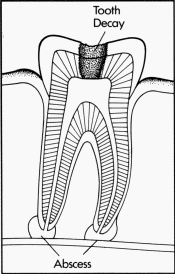
If
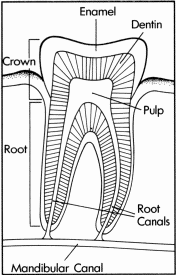
left untreated, the decay will continue to progress through the
tooth structure until it reaches the pulp. The pulp chamber
houses the nerve and blood supply for the tooth. When decay
reaches the pulp, an abscess ensues which is associated with tremendous
pain. Once the decay is in the chamber, the only choice of
treatments are Root Canal Therapy or Extraction of the tooth.
Back to
top
How long after a
meal does it take for this acid to be produced?
This depends
on the person, the frequency of snacking, and the amount of available
sugar present. Studies have shown that an acid environment can
be created as quickly as 30 minutes after a meal and could last
for hours.
Back to
top
How
do we prevent tooth decay?
The best way
to prevent decay from forming is by cleaning our mouths, thus
removing all the stray bits of food. This can be accomplished
by brushing and flossing your teeth. If there is no food for the
bacteria to digest, then they cannot create the acid needed to
cause decay. Also repeated fluoride treatments and protective
sealants have been shown to decrease the effects of the harmful
acid that causes decay.
Back to
top
How
does fluoride prevent decay?
Fluoride helps
prevent decay by making our teeth more resistant to the acid that
is produced. If we brush regularly with fluoridated toothpaste
and receive fluoride treatments, more fluoride will get incorporated
into the structure of our teeth, and the bacteria will have to
produce much more acid.
The best
time to introduce fluoride to the teeth is when they are still
forming in the jaws. This can be accomplished quite simply by
allowing children to consume properly fluoridated water (7 parts
per million), or a fluoride supplement (for children growing up
in non-fluoridated communities).
Back to
top
How do sealants prevent
decay?
Typically, posterior
teeth have deep grooves that are impossible to keep clean, despite
how often you brush. This is because, these grooves become microscopically
small and the bristles of a tooth brush cannot reach them. As
you eat, food and bacteria get stuck in these grooves. The bacteria
then produce the harmful acid which in turn cause cavities to
form. After being placed on the chewing surfaces of a tooth, the
sealant hermetically seals these grooves, thus preventing food
and bacteria from getting into the grooves. Also the sealant material
makes the tooth more resistant to the harmful acid that can form
cavities.

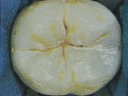
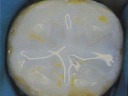
Toothbrush
Bristle
Before
After can not fit in grooves
Back
to top
Nursing & Baby
Bottle Tooth Decay?
Proper dental care is a lifelong commitment that starts even before
your baby�s first tooth forms. While daily cleanings and fluoride are
important, they alone may not prevent Nursing Decay a major cause of
tooth decay in infants. Nursing Decay is costly to treat. If left
untreated, however, it can quickly destroy the teeth involved. It
also can lead to pain, infection, early loss of baby teeth, crooked
permanent teeth, and an increased risk of decay in permanent teeth.
When you consider the possible dental problems that can result from
Nursing Decay and the cost of treating those problems, it is best to
prevent Nursing Decay from developing in the first place.

Back
to top
HOW
DOES NURSING DECAY DEVELOP?
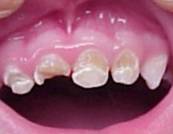
Nursing
Decay can develop if your child�s teeth and gums are in prolonged
contact with almost any liquid other than water. This can happen from
putting your child to bed with a bottle of formula, milk, juice, soft
drinks, sugar water, sugared drinks, etc. Allowing your baby to suck on
a bottle or breastfeed for longer than a mealtime, either when awake or
asleep, also can cause Nursing Decay.
When
liquid from a baby bottle builds up in the mouth, the natural or added
sugars found in the liquid are changed to acid by germs in the mouth.
This acid then starts to dissolve the teeth (mainly the upper front
teeth), causing them to decay. Nursing Decay can lead to severe damage
to your child�s teeth and also can cause dental problems that affect
your child�s permanent teeth.
Back
to top
WHY
ARE BABY TEETH IMPORTANT?
Many
parents assume that decay does not matter in baby teeth because the
teeth will fall out anyway, but decay in baby teeth poses risks. If
your child loses his baby teeth too early because of decay or infection,
the permanent teeth will not be ready to replace them yet. Baby teeth
act as a guide for the permanent teeth. If baby teeth are lost too
early, the teeth that are left may shift position to fill in the gaps.
This may not leave any room for the permanent teeth to come in.
Back
to top
WHAT
CAN I DO TO PREVENT NURSING DECAY?
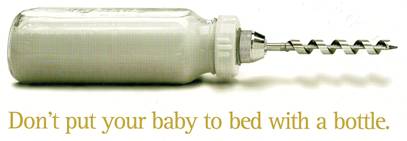
- Never put your
child to bed with a bottle. By 7 or 8 months of age, most children no
longer need feedings during the night. Children who drink bottles
while lying down also may be more prone to getting ear infection.
- Only give your
baby a bottle during meals. Do not use the bottle as a pacifier, do
not allow your child to walk around with it or to drink it for
extended periods. These practices not only may lead to Nursing Decay,
but children can suffer tooth injuries if they fall while sucking on a
bottle.
- Teach your child
to drink from a cup as soon as possible, usually by 1 year of age.
Drinking from a cup does not cause the liquid to collect around the
teeth, and a cup cannot be taken to bed. If you are concerned that a
cup may be messier than a bottle, especially when you are away from
home, use one that has a snap-on lid with a straw or a special valve
to prevent spilling.
- If your child
must have a bottle for long periods, fill it only with water.
Keeping
your baby�s mouth clean is also important in preventing tooth decay.
After feedings, gently brush your baby�s gums and any baby teeth with a
soft infant toothbrush.
Start
using water and a soft child sized toothbrush for daily cleanings once
your child has seven to eight teeth. By the time your toddler is 2
years of age, you should be brushing her teeth once or twice a day,
preferable after breakfast and before bedtime. Begin using fluoride
toothpaste when you are sure the toothpaste will not be swallowed
(usually when your child is around 3 years of age). Use a pea-sized
amount of toothpaste to limit the amount your child can swallow. Too
much fluoride can be harmful to a child.
Back
to top
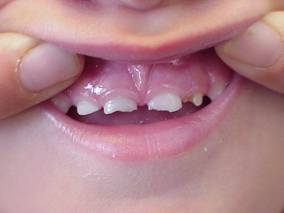
DETECT NURSING DECAY EARLY
Nursing
Decay first shows up as white spots on the front teeth. These spots are
hard to see at first-even for a pediatrician or dentist- without proper
equipment. A child with tooth decay needs to get treatment early to
stop the decay from spreading and to prevent lasting damage to the
teeth. If you are concerned that your child may have Nursing Decay, your
pediatrician can refer you to a pediatric dentist who will carefully
examine your child�s teeth for signs of decay. With the right balance of
proper home and professional dental care, your child can grow up to have
healthy teeth for a lifetime of smiles.
Back
to top
The above is an oversimplified
discussion on tooth decay. If you have any questions please feel free
to contact Dr. Bialik at, 246 Federal Road, Suite D-13, Brookfield,
CT 06804, (203) 791 – 2771.
Scott
A. Bialik, D.D.S.
Pediatric Dentistry
246 Federal
Road, Suite D- 13, Brookfield, CT 06804
(203)
791 - 2771
(203)
775 - 8287
If
you would like e-mail Dr. Bialik please forward your comments to
[email protected]
   
Flexible
Payment Plans Available
|